
Quick answer: A beachhead market is the one narrow group of customers a startup sets out to win first: small enough to dominate, with a problem urgent enough that they will buy within 3 to 6 months. For an AI agent security or governance startup, it means picking one buyer, one problem and one region, instead of selling "agent security" to every enterprise.
Agent security went from an empty category to a crowded one in about a year. In September 2026, AIR came out of stealth with a $50 million seed round, and CB Insights now tracks 163 private companies in AI agent security and risk management.
When every startup says "secure your agents," buyers can't tell you apart. Design partners stall, calls go nowhere, and the founder ends up pitching a different buyer every week. Choosing a beachhead market is how you get out of that loop.
In this guide you'll learn:
- What a beachhead market is, and where the idea comes from
- How a beachhead differs from your TAM and your ideal customer profile
- Why agent security and governance founders need one now
- What a good beachhead looks like in this category
- A 5-step way to choose yours
What is a beachhead market?
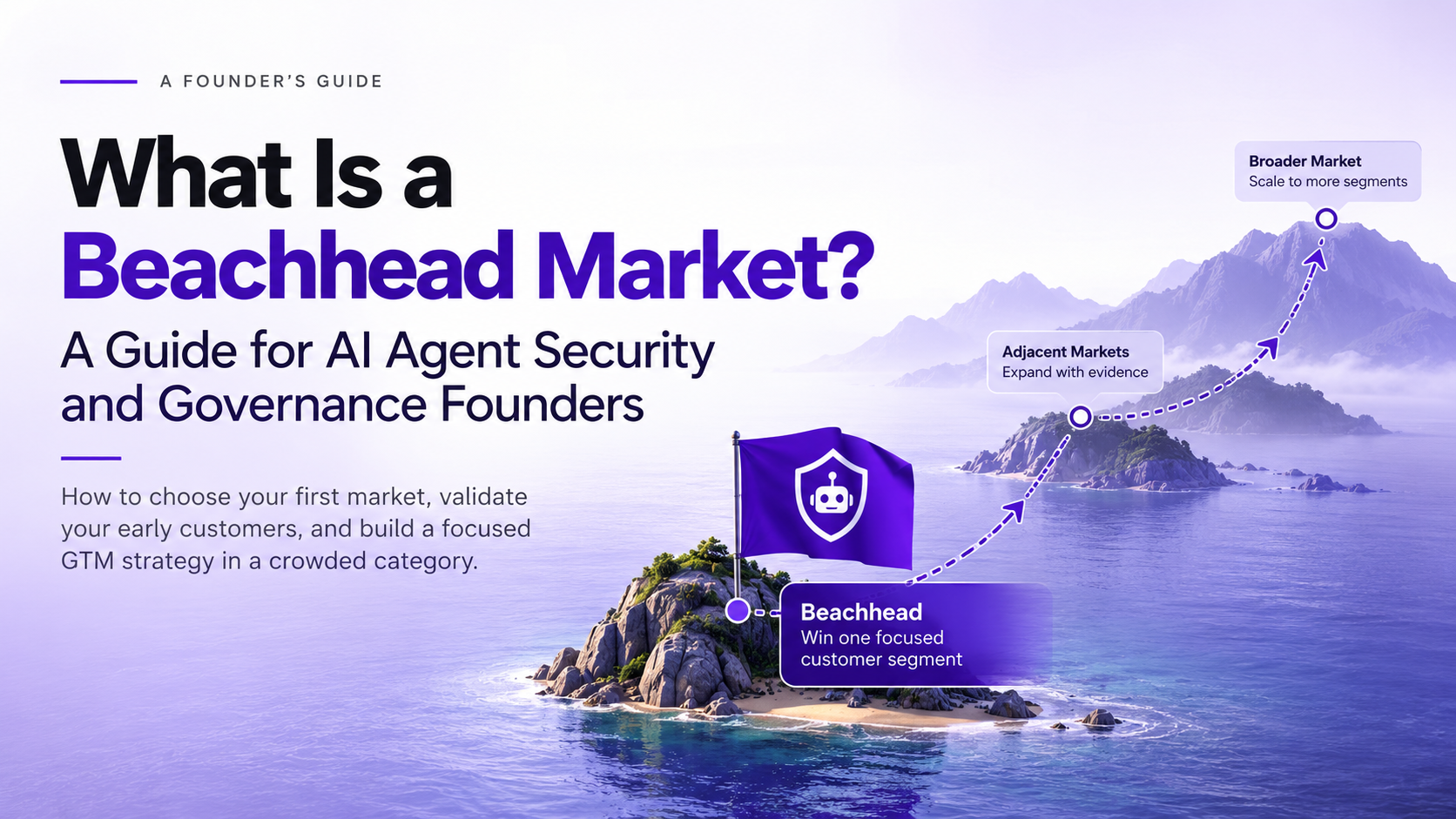
A beachhead market is the first, deliberately narrow market segment a company focuses on until it wins a large share of it. The term comes from military landings: an army first secures one small stretch of beach, then uses it as a base to move inland.
Geoffrey Moore made the idea popular in tech with Crossing the Chasm, using the D-Day landings as his analogy for winning one niche before going mainstream. Bill Aulet's Disciplined Entrepreneurship later made "select a beachhead market" one of the first steps for any new venture.
What makes a market a good beachhead?
Aulet describes three tests, which still hold up well:
- Customers buy similar things. They have the same problem and want roughly the same solution.
- They buy the same way. Similar sales cycle, similar budget owner, similar value expected.
- They talk to each other. Word of mouth travels, so one happy customer leads to the next.
If a segment fails any of these, every sale feels like starting over.
Beachhead market vs TAM vs ICP: what's the difference?
Founders often mix these up. They answer different questions.
| Term | Question it answers | Agent security example |
|---|---|---|
| TAM (total addressable market) | How big could this get? | Every enterprise running AI agents |
| Beachhead market | Where do we win first? | Mid-size UK and German banks whose risk team must approve every new agent |
| ICP (ideal customer profile) | Who is our best customer at scale? | Regulated enterprises with 500+ agents in production |
| ECP (Early Customer Profile) | Who buys from us right now? | Banks already piloting customer-facing agents, with a named AI risk owner |
The TAM is what investors ask about. The beachhead is where you actually spend the next six months. The Early Customer Profile, a term from Maja Voje's beachhead framework, describes the first buyers inside that beachhead.
Why do AI agent security and governance startups need a beachhead?
Because the category moved faster than buyers did. Four problems show up again and again:
- Lookalike positioning. Most launches lead with the same attack demo or the same "visibility and control" promise.
- No clear budget owner. Depending on the company, the CISO, AppSec, the AI platform team or risk and compliance might sign. Selling to all of them means convincing none of them.
- Limited founder time. At seed stage, the technical founder is often the only seller, and every unfocused call costs engineering time.
- Investors want proof of a repeatable buyer. A Series A story is far stronger with "we win mid-size banks in London" than with "we have design partners in five industries."
More on the founder's role in my post on why founder-led GTM is not about the founder.
What happens without a beachhead?
You spread a small team across many segments and never get enough conversations in any one of them to learn what works. You end up with many half-answers and still no decision. Narrowing feels like leaving money on the table, but it is usually how the money starts.
What does a good beachhead market look like in agent security?
A good beachhead is specific enough that you could build a list of every company in it tomorrow. Here is how one agent governance startup might narrow down:
- Too broad: Enterprises using AI agents
- Still broad: Regulated enterprises using AI agents
- Getting there: Banks in the UK and Germany running customer-facing agents
- Beachhead: Mid-size UK and German banks whose risk team must approve every new agent
At step 4, the buyer is clear (the head of AI risk), the pain is urgent (regulators are asking questions), and the banks talk to each other through the same industry events.
An agent security startup might land somewhere different, for example: "US fintechs in New York with agents that touch customer payments, where AppSec owns the budget." Same method, different beachhead.
How do you choose your beachhead market? 5 steps
Use these five steps to turn a broad market hypothesis into a focused experiment.
- List 10 to 20 segments by the job your product does, not by company size. "Banks that must approve every agent" beats "enterprises with 1,000+ employees".
- Score each segment from 1 to 5 on speed to buy, ability to pay, strength of pain, market growth and your access to the buyers. Access is the one founders skip, and it often decides the winner.
- Test your top one or two with real buyers: 5 to 10 conversations, then a small outbound test. A booked call or a paid pilot is proof; a compliment is not.
- Write an Early Customer Profile: one page on who signs, what triggers a purchase and who they trust. Expect to rewrite it every few months.
- Plan your expansion waves: stay in the beachhead until you have a few paying customers and case studies, then move to the segment next door.
Turn the framework into a working document. List your candidate segments, score them against the five criteria, and record what you learn from each buyer conversation. Update the scores as evidence comes in.
How do you know you picked the wrong beachhead?
Watch for these signs in the first 8 weeks:
- You can't find at least 50 companies that fit it.
- Every discovery call has a different buyer.
- Replies are polite compliments, not booked calls.
- You'd need three different homepages to speak to everyone in it.
- Nobody pays for a pilot, even at a low price.
If two or more are true, go back to step 2 and re-score. Picking a beachhead often takes several rounds.
Common beachhead mistakes agent security founders make
- Choosing the biggest market instead of the most winnable one. "Fortune 500" sounds great and moves slowly.
- Defining the segment by headcount only, instead of by the problem.
- Testing too many segments at once, so none gets enough conversations to learn from.
- Skipping real conversations and relying on AI-generated personas.
- Changing public messaging before the test is done. Keep tests quiet until you have a winner.
Key takeaways
- A beachhead market is the one narrow segment you set out to win first.
- It is not your TAM or your long-term ICP; it's where you win in the next 3 to 6 months.
- In a crowded category like agent security, a clear beachhead is what makes your message stand out.
- Pick it by job to be done, score for winnability, and let real buyers decide.
Which segment would you bet on today if you could only pick one? If you're unsure, start with the five-step framework and test your strongest hypothesis.
For help applying this to your product, explore our AI Agent Infrastructure GTM solution and Founder-led GTM Engineering service. Both connect market hypotheses to buyer conversations, signals, and the next experiment.
Want help defining your beachhead market and landing your first 10 pilot customers? I work with AI agent security and governance founders to pick the market they can win, test it with real buyers, and turn the first conversations into paying pilots for their product.
Frequently asked questions
What is a beachhead market in simple terms?
A beachhead market is the first small group of customers a startup focuses on winning before expanding. It is narrow enough that the startup can become the obvious choice within it, and its customers share the same problem, buy the same way and talk to each other.
How big should a beachhead market be?
A beachhead market should be small enough to win a large share of within a year or two, but big enough to support your first revenue goals. For a seed-stage agent security startup, a few hundred target companies is often plenty. If you can't name the first 50, it is too vague.
What is the difference between a beachhead market and an ICP?
A beachhead market is where you win first; an ideal customer profile (ICP) describes your best customer at scale. The beachhead is usually a narrower slice of the ICP, chosen because those buyers will purchase sooner, with less social proof and shorter sales cycles.
How long should a startup stay in its beachhead market?
Most startups should stay in their beachhead market for at least 3 to 6 months, or until they have several paying customers and two case studies. Moving on too early spreads a small team thin before it has a repeatable way to win.
Can a startup test two beachhead markets at once?
Yes. Testing two beachhead candidates side by side is a good way to decide, as long as both get the same offer, the same effort and the same number of prospects. Keep the test quiet, pick the winner after about 8 weeks, then commit to one.
Is a beachhead market the same as a niche?
Not quite. A niche can be a permanent business focus. A beachhead market is a starting point: you win it first, then use its customers, case studies and referrals to expand into neighboring segments.