
GTM Engineering is becoming one of the most interesting roles in modern B2B SaaS.
But if you are new to the term, it can be confusing.
Is a GTM Engineer a marketer?
A salesperson?
A RevOps person?
An automation specialist?
Or an AI engineer?
The answer is: a little bit of all of these, but not exactly any one of them.
A GTM Engineer sits at the intersection of GTM strategy, data, automation, software, AI, and revenue operations.
The easiest way to understand the role is this:
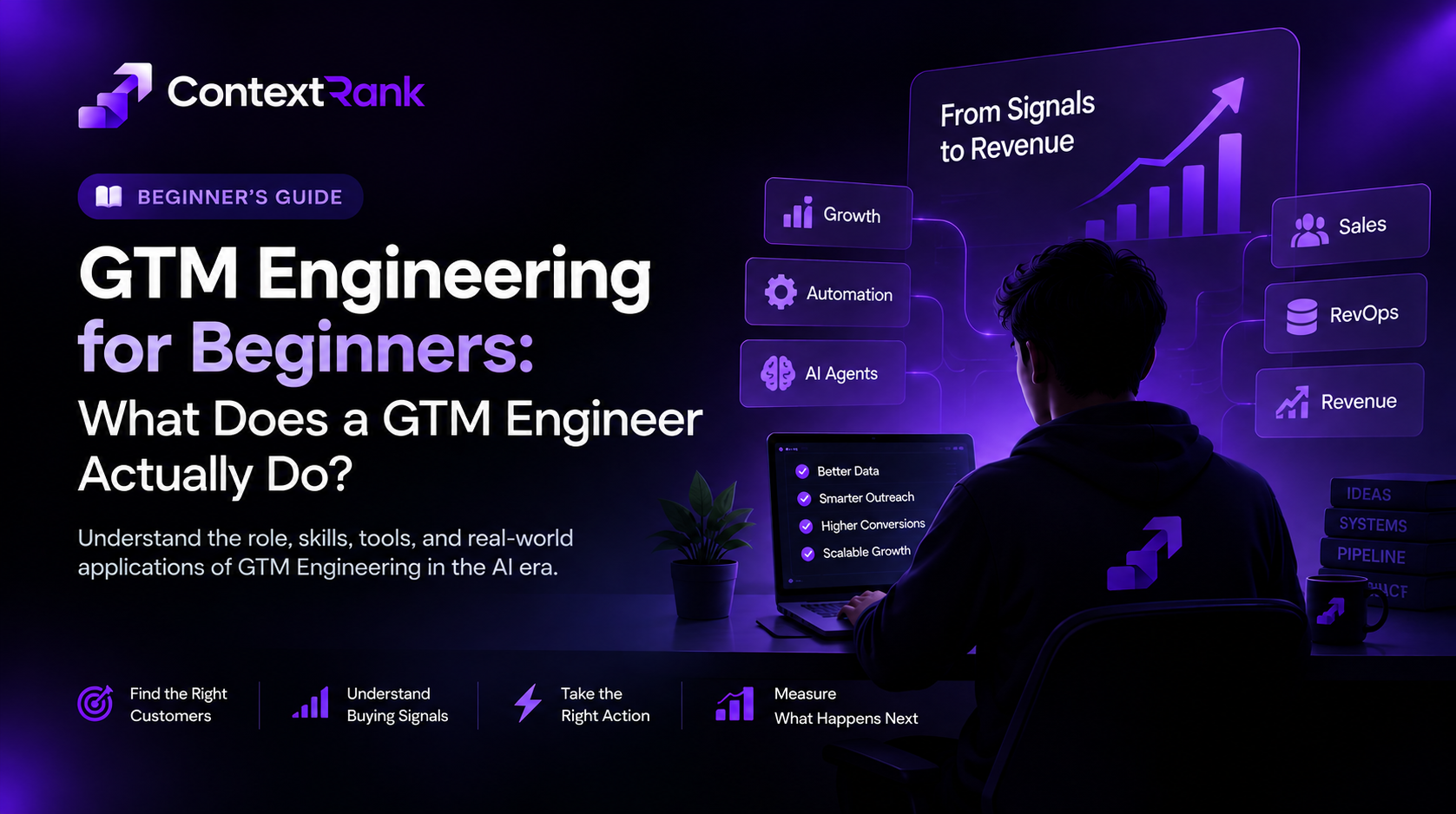
A GTM Engineer builds the technical systems that help a company find the right customers, understand buying signals, take the right action, and measure what happens next.
That means the role is much bigger than knowing how to use a collection of GTM tools.
It is about understanding the problem behind the tools.
If you are interested in how founder-led companies can build these systems, you can also read more about Founder-Led GTM Engineering.
What Is GTM Engineering?
GTM Engineering is the practice of using software, data, APIs, automation, and AI to improve how a company acquires, converts, and retains customers.
A GTM Engineer might work on:
- Lead enrichment
- Account research
- Lead scoring
- Signal detection
- CRM automation
- Personalized outreach
- AI research agents
- Data pipelines
- Pipeline management
- Revenue analytics
- Internal GTM tools
The role exists because modern GTM teams use a large number of disconnected systems.
Marketing may have one set of tools.
Sales may have another.
RevOps manages the CRM.
Growth teams collect behavioral signals.
AI systems introduce another layer of capabilities.
Someone needs to connect these systems and turn them into something the revenue team can actually use.
That is where GTM Engineering comes in.
GTM Engineer vs RevOps
One of the easiest ways to understand GTM Engineering is to compare it with RevOps.
RevOps traditionally focuses on making revenue processes more efficient and consistent.
This can include:
- CRM administration
- Reporting
- Forecasting
- Process management
- Data governance
- Revenue operations
GTM Engineering goes further into building.
A GTM Engineer may need to work with:
- APIs
- Python
- SQL
- Webhooks
- Data pipelines
- AI agents
- Automation platforms
- CRM integrations
- Workflow orchestration
The difference is not absolute.
There is significant overlap between the two roles.
But the GTM Engineer typically has a stronger builder mindset.
Instead of only asking:
"How can we improve this process?"
They may also ask:
"Can I build a system that changes how this process works?"
That is an important difference.
The Four Areas a GTM Engineer Works Across
A useful way to understand the role is through four major areas.
1. Growth
Growth is about creating and capturing demand.
This can include:
- Demand generation
- Campaign automation
- Website signals
- Intent data
- Audience building
- Content distribution
The important part is not simply generating more activity.
It is identifying which activity actually matters.
For example, one website visit may not tell you much.
But if a company matches your target customer profile, visits your pricing page, returns several times, and has recently experienced a relevant business change, the combined information becomes more useful.
This is where GTM Engineering starts becoming signal engineering.
The goal is not to collect as much data as possible.
The goal is to collect the right signals and put them into the right context.
2. Signal Routing
Once you have a signal, someone needs to decide what happens next.
Imagine a target account shows a strong buying signal.
A GTM system may need to determine:
- Is this actually the right company?
- Does it fit our target customer profile?
- Who are the relevant people?
- What information already exists in the CRM?
- What triggered the signal?
- How recent is the signal?
- How strong is the intent?
- Should sales act now?
- Should the account be nurtured instead?
This is where data enrichment, scoring, routing, and business rules become important.
A GTM Engineer is not simply building a database of prospects.
They are helping the revenue team make better decisions from the data.
3. Warm Outreach
The next area is turning context into relevant engagement.
Traditional outbound often starts with:
"Here is a list of companies. Now let us send them messages."
GTM Engineering allows the process to become more contextual.
For example, a company might recently:
- Hire for a new department
- Launch a product
- Enter a new market
- Change its technology stack
- Publish research
- Receive funding
- Engage with relevant content
Instead of treating every company the same, the system can use these signals to help determine who to contact, why now, and what context should be included.
AI can help with research, summarization, qualification, and personalization.
But this does not mean everything should be automated.
A good GTM system separates data retrieval, business rules, AI reasoning, tool execution, and human approval.
External communication, for example, can still require human review.
4. Pipeline Operations
The final area is the operational foundation.
This includes:
- CRM management
- Data enrichment
- Workflow automation
- Deduplication
- Lead routing
- Pipeline management
- Error handling
- Reporting
- Data quality
This part may not look as exciting as an AI agent.
But it is extremely important.
Imagine building an AI qualification agent when your CRM contains duplicate companies, outdated contacts, missing fields, and inconsistent ownership.
The AI will simply produce decisions using unreliable information.
That is why GTM Engineering requires an understanding of data models, APIs, validation, retries, error handling, and system reliability.
Where Does AI Fit Into GTM Engineering?
AI adds a reasoning layer to GTM systems.
For example, an AI system can help answer:
What happened with this account?
Why might this signal matter?
Does this company fit our target profile?
Who is the relevant decision-maker?
What information should a salesperson know before contacting them?
What action should happen next?
This is different from simply asking an AI model to write an email.
The real opportunity is using AI to interpret information inside a larger GTM system.
That system might combine:
- CRM data
- Company information
- Website activity
- Intent signals
- LinkedIn activity
- Product usage
- Customer conversations
- External research
The AI then helps turn that context into a recommendation.
This is why context engineering, tool use, structured outputs, agent design, evaluation, and human-in-the-loop systems are becoming important GTM Engineering skills.
If you want to understand how AI agents can be developed for business workflows, see AI Agent Development.
What Skills Does a GTM Engineer Need?
You do not need to become an expert in every technology.
But you need enough technical depth to build and understand GTM systems.
Python
Python helps with custom logic, data transformation, API integrations, validation, scoring, batch processing, and internal tools.
APIs
GTM systems are integration-heavy.
You need to understand HTTP, JSON, authentication, webhooks, pagination, rate limits, retries, and API errors.
SQL
SQL helps you understand the commercial data layer.
You should eventually be able to answer questions such as:
- Which accounts match our target profile?
- Which leads were routed incorrectly?
- Which signals preceded meetings?
- Where are opportunities getting stuck?
- Which campaigns created qualified pipeline?
Automation
Tools such as n8n can help connect different systems and automate repetitive processes.
But knowing the tool is only part of the skill.
You need to understand the process you are automating.
AI Agents
You should understand:
- Tool calling
- Structured outputs
- Context engineering
- Retrieval
- Agent workflows
- Human approval
- Guardrails
- Evaluation
The objective is not to build the biggest possible agent.
Start with a narrow business problem.
For example:
Account Research Agent
Inbound Qualification Agent
CRM Data Quality Agent
Competitive Intelligence Agent
Narrow agents are easier to test, improve, and govern.
The Biggest Mistake Beginners Make
A common mistake is thinking:
"I need to learn more GTM tools."
So they start learning one platform after another.
CRM.
Enrichment.
Outbound.
Automation.
AI.
Another AI platform.
Another data provider.
But tool knowledge alone does not create a GTM Engineer.
The more important skill is problem-solving.
If a founder tells you:
"We have enough leads, but sales cannot identify which accounts deserve attention."
You should be able to investigate the problem.
Is the ICP unclear?
Is the data incomplete?
Are signals missing?
Is lead scoring weak?
Is routing incorrect?
Is the CRM poorly structured?
Is the team receiving too much low-quality information?
Only after understanding the problem should you decide what to build.
That is the difference between tool operation and GTM Engineering.
How I Would Learn GTM Engineering as a Beginner
I would not start with multi-agent systems.
Start with the fundamentals.
Step 1: Understand GTM
Learn:
- ICP
- Buyer personas
- Lead qualification
- Pipeline
- Outbound
- Inbound
- ABM
- PLG
- Revenue metrics
Step 2: Learn Automation
Build simple workflows using APIs, webhooks, CRM systems, and automation platforms.
Step 3: Learn Python and SQL
Start building small utilities instead of relying entirely on no-code tools.
Step 4: Learn AI Systems
Understand model APIs, structured outputs, tool calling, retrieval, context engineering, and agents.
Step 5: Learn Production Systems
Add:
- Evaluation
- Observability
- Error handling
- Security
- Cost control
- Human approval
Step 6: Go Deep Into One GTM Motion
Choose an area such as:
- B2B outbound
- Founder-led GTM
- ABM
- PLG
- Enterprise sales
- Customer expansion
Technical breadth gives you the ability to build.
GTM depth gives you the judgment to know what to build.
What Makes a Good GTM Engineer?
It is not the number of tools they know.
It is not the number of AI agents they have built.
And it is not how complicated their automation looks.
A strong GTM Engineer can take a business problem and work through:
What is the problem?
What data do we need?
What signals matter?
What should be automated?
Where should AI be used?
Where should deterministic rules be used?
Where does a human need to make the decision?
How will we measure whether it worked?
That is the real skill.
GTM Engineering is moving from tool operation toward revenue-system design.
The role combines technical execution with commercial judgment.
And that is what makes it interesting.
You do not need to become a salesperson who knows some code.
You do not need to become a software engineer who happens to work in sales.
You need to learn how technology, data, AI, and GTM strategy work together.
That is the foundation of GTM Engineering.
And I think that is the part worth learning first.
Building Your GTM System?
If you are a founder or GTM leader trying to understand where AI, automation, data, and GTM Engineering can fit into your current process, I offer GTM consultation sessions focused on the problem you are trying to solve.
You can also connect with me on LinkedIn.